Why is the Brother of Jared not Named in The Book of Mormon
By Daris
Howard
The Sumerian Book of Kings These insights I share are based on years of research and lots of questions I have received at Education Week presentations. I’ll try to make the articles more concise and will have to leave out some of the humor and detail that the book contains. The reference numbers will be kept the same as in the book to help avoid any confusion in the different articles. For this first article, I will address the question
most often asked of me: “Why is The Brother of Jared not named in The Book of
Mormon?” My answer to that is that I think he is. Let me explain what I mean. Before
I discuss this, it should be mentioned that we know the name of Jared’s brother
as Mahonri Moriancumer, given through modern revelation to the prophet Joseph
Smith [34]. So why didn’t Moroni record that in The Book of Mormon? There
is something else to consider. It
appears that Jared is the oldest, while his younger brother is the
prophet. I suggest Jared is the oldest
because he is the one who makes the decisions for the people and asks his
brother to go to the Lord on behalf of the people. Having an older brother leader and a younger
brother prophet is not without precedence. In
Egypt, Aaron was one of the leaders of the people, and Moses was his younger
brother and also the prophet. Moses, of
course, was called by God and became more of the leader under God’s direction
than Aaron. In the Book of Mormon, this
type of relationship appears to hold with Ammon and Aaron, the sons of
Mosiah. A person might include Laman and
Nephi in this list. In modern times,
Hyrum was the patriarch, and Joseph was the prophet. Again, an older brother is a leader and a
younger brother is the prophet. This age
ordering could be important, as we will see later on. There
are many reasons that have been given as possibilities for the lack of a
name. The list I have found from other
scholars includes: 1. The record is kept by those in Jared’s family line,
and Ether included only the names of his progenitors. 2.
The brother of Jared may have omitted his name out of modesty
(John the Beloved did essentially the same thing in the Gospel of John, which
he wrote).
4.
In the Roman practice of damnatio
memoroae, names were intentionally removed from the record. Egyptian
factions also wiped out names and statues of heretical rivals. In Ether
11:17–18, a direct descendant of the brother of Jared, and rival king, is also
not named.
1)
Record kept by Jared’s descendants. Both Hugh Nibley 2)
The Brother of Jared’s name was omitted out of modesty. The idea that The Brother of Jared left his
own name out because of modesty is suggested by Ludlow [12]. This seems unlikely since there are too many
instances in the book of Ether where names have been omitted. Some of these are men lusting for power, and
the probability such men would have their names omitted is close to zero. If the brother of Jared was the only one, it
would be understandable. But since there
are so many others, the omissions are common, so there needs to be a more
common reason. 3)
Moroni having trouble with translation. Moroni having trouble with the translation is
also suggested by Ludlow [12] and seems plausible since Moroni talks about how
challenging it was. Moroni’s written
language, based on Egyptian, was more symbol and meaning based and could have
caused problems between the translations.
For this reason, the challenge to translate from the Jaredite language
to the Nephite language tends to be a reasonable idea for why The Brother of
Jared’s name was not given. I think this
is half of the equation, but not the complete answer. 4) The Roman
practice of damnatio memoroae. Wikipedia mentions the Roman practice of damnatio
memoroae [35] but does not credit the person who made this suggestion. It
is true that names were intentionally removed from records. Egyptian factions
also wiped out the names and statues of heretical rivals. In Ether 11:17–18, a
direct descendant of the brother of Jared, a rival king, is also not named, as
are many others, which makes this seem unlikely. Now that I
have reviewed what others have considered, I would like to suggest here a
couple more possible reasons from my own research. 5. Custom of deferring to the leader. 6. Sumerian naming conventions. 5)
Custom of deferring to the leader. There was a custom of naming convention in Asia (the culture
most similar to that of the Jaredites) of deferring to leaders. This was because of many reasons, but one big
reason was that a king would work to make his legacy, and he did not want
someone else receiving his glory because they had the same name. In ancient Chinese and Japanese cultures, certain restrictions were
put into law regarding someone else having a name similar to the emperor or his
progenitors [37]. This was both a
cultural and a religious norm. A person
with a name like the emperor’s, or his ancestors’, was considered as lacking
education and respect and bringing shame on himself and the emperor. This could include just writing the name of
the emperor without permission. The
result of violations of the law could be severe, including death for the person
and their family members.
Sometimes
when someone became the emperor, anyone with a similar name had to change their
name, or at least remove or change important characters, to avoid the execution
of the law. Some emperors would change
their own names when they became emperors to avoid the problem. It also became common practice for the
parents of a child who could grow up to be an emperor to give the child a
unique or uncommon name to avoid problems should the child become the emperor. Sometimes, those close to the emperor could be
given names based on relation such as “Brother of” the emperor or “Sister of”
the emperor. Since
I finished my book, we have actually seen a form of this in North Korea. As Kim Jong Un’s daughter, Kim Ju-ae, has come to prominence as his
possible successor, any girl with that same name was forced to change her
name. (See https://www.scmp.com/news/asia/east-asia/article/3209935/north-korea-forces-people-same-name-kim-jong-uns-daughter-ju-ae-change-it-report.) There is a lot more to this that we don’t have
space for here, but it could be that since Jared was the
leader, his brother’s name was not mentioned so as not to diminish from Jared’s
preeminence. I feel the scriptures indicate a mutual respect between the
brothers, and I don’t feel this is an appropriate explanation. 6)
Sumerian Naming Convention.
The Sumerian naming convention seems to give a plausible explanation as
to why The Brother of Jared is not named. As I worked further on this, I searched Sumerian references for
anything related to names or parts of them as possible prefixes and
suffixes. Sumer was an area in
Mesopotamia where possible ties could be found to the Jaredites. Their culture predated the Babylonians, however
no one knew they existed until relatively recently [29]. There have been many clay tablets found in the Mesopotamian
valley. Many of these had writings that
could not be interpreted. In the 1800s,
a pillar was found with different writings.
Many scholars thought they were different things. But, as multiple people worked on the
translation, they eventually realized the various writings were of the same
thing, like the Rosetta Stone. Working
on these ultimately made it possible to translate them and gain the
understanding to translate the clay tablets and other writings. These translations brought to light the
culture and people of Sumer who were not known before that time. The abundance of tablets and other writings
gave us more understanding of them and surrounding areas, like Akkad and Elam,
than we have of many ancient civilizations [29]. The
Sumerians, or related people, were likely the ones building the Tower of Babel
or living in that vicinity. The
Jaredites, therefore, would likely have come from that culture. Some of the names in the book of Ether are
extremely Sumerian. For example, one of
the most powerful Sumer city-states was Kish, and Kish is the name of a king in
Ether 10. 17 And it came to pass that Corom did that which was good in
the sight of the Lord all his days; and he begat many sons and daughters; and
after he had seen many days he did pass away, even like unto the rest of the
earth; and Kish reigned in his stead. 18 And it came to pass that Kish passed away also, and Lib
reigned in his stead.
In
fact, “Kish” is part of names throughout the book of Ether, such as Akish and
Riplikish. It can also be found in a
Nephite name later, KishKumen. It is
also a Bible name. In fact, King Saul
was the son of a man named Kish (1 Samuel 9:1-2). In
Sumer, names were often given based on something about the person and could be
a whole sentence. These names were often
words compounded together and could be long,
Names
could also be changed after birth to match something about the person. For example, a girl who was found as the only
survivor after her village was washed away was given the name Tila, meaning
“The one who survived” [38]. Some of
these names are found on clay-baked tablets from the Temple School of Nippura
[39]. Example
tablet from Nippura Examples
of Sumerian names can be useful. Here are a few examples of some names
from Sumer that are listed along with their word meaning [40]: Ses-tur: little brother Ama-i-de: mother by the canal Abzu-kurgal: the Abzu is a great
mountain Ĝakanaheti: may (this child) live for
my sake Gu-be: next to the riverbank Guduga: one with a sweet voice Iginisig: blue/green eyed one Inimzida: having righteous words
The
name Jared is a pre-flood name, first found in Genesis 5:18-20: 18 And Jared lived an hundred sixty and two years, and he
begat Enoch: 19 And Jared lived after he begat Enoch eight hundred years,
and begat sons and daughters: 20 And all the days of Jared were nine hundred sixty and two
years: and he died.
The name Jared as found in the Book of Jubilees, a
noncanonical book that is found in some religions and correlates to the Old
Testament book of Genesis, indicates the name Jared means “to descend”
(Jubilees 4:15) [41]. This could relate
to the descending of angels in early Biblical writings. So, in Sumerian, we might consider Jared to
mean “He Who Descends,” or perhaps “He Who Came Down From Heaven.” As a parent, I can imagine a mother naming
her baby this.
As explained in the Sumerian name convention, a name can be
given related to the person and what they have done. This can be changed later
in life. This is not without precedence in other cultures. The Chinese were
another culture that did this a lot, as were the Native Americans.
I had a good friend when I was young whose last name was
Red Fox. Native American names and their
translation can also give us some insight.
A small sampling includes [42]:
For Men: Dustu –
Cherokee. Spring frog Enapay –
Sioux. Appears bravely. Keokuk –
Sauk. One who is alert and watchful. Kosumi –
Miwok. Fishes for salmon with a spear. Seattle –
Salish. Man of high status. For Women: Nokomis –
Chippewa. Daughter of the moon. Winona –
Sioux. The first daughter.
Hawaiians still give such names today. I have some Hawaiian friends with names long
enough that they are almost impossible for someone who does not speak the
language to remember. I can’t say the
names, let alone remember them, so we use something much shorter.
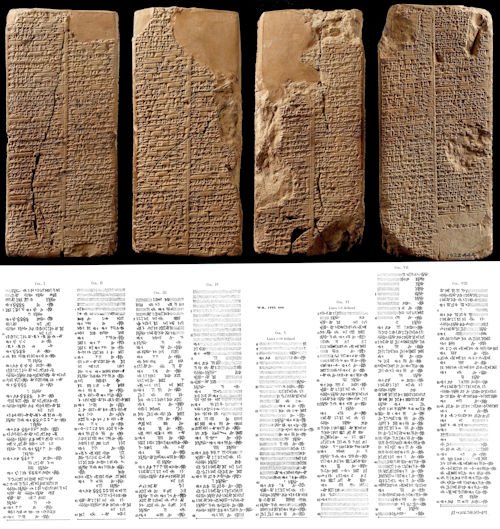
In the Sumerian King List, there are names of the kings
recorded on baked clay tablets [43]. In the
list, the names are translated, along with their meaning, when known. In most cases, these kings became kings after
their fathers, and their name meant “Son of WhoeverTheLastKingWas.” Dumu, “Son of” or “Child of” appears to be
the most common part of a name. Other
common things include a city, land, or something that indicated the place the
person came from.
At least in one case in the Sumerian List of Kings, there
is a brother reference. Manishtushu
means “brother of Rimush, the son of Sargon.”
(His brother was the king before him.)
As I considered the naming convention of the Sumerians, I realized
the names of the people in the book of Ether likely all had a meaning. And it came to me that the name of the
brother of Jared could translate just as that.
His name is “The Brother of Jared” when translated. It is possible that when Moroni translated
the record using the interpreters, the translation given was the name’s meaning
and not how the name sounds. This could
mean that others whose names we considered as not given actually were given,
but in the form of the meaning. For example, information on Sumer [44] talks about how a common
name for a king, or at least a portion of the king’s name, would be
lu-gal. This means “great man” or “king”
and might be the reason we find some men in the book of Ether given as “A
Mighty Man” or something similar. That
might be the translated name by meaning and not by sound. Ether 11: 15 And it came to pass that there arose a rebellion among the
people, because of that secret combination which was built up to get power
and gain; and there arose a mighty man among them in iniquity, and gave
battle unto Moron, in which he did overthrow the half of the kingdom; and he
did maintain the half of the kingdom for many years.
Ether 11: 17 And it came to pass that there arose another mighty man;
and he was a descendant of the brother of Jared.
In other words, maybe in wondering why the brother of Jared
is not named, we (or at least I) have been looking beyond the mark. Maybe “The Brother of Jared” is his name as
translated by meaning, and not phonetically, and that is the reason it is in
the book of Ether that way. Perhaps
Mahonri Moriancumer even translates as “The Brother of Jared,” and we have,
therefore, actually had his name in the book of Ether in its meaning form and
not in its phonetic form.
I think that if Mahonri Moriancumer does translate to “The
Brother of Jared,” that this is only a portion of the translation. The reason for this is that in Sumerian
names, Mah (as is part of the name Mahonri) has a definition of “chief,
exalted, or large” [45]). It is
interesting to note that the brother of Jared is called a large man. (Note the phrase “mighty man” is also here
again.)
Ether 1: 34 And the
brother of Jared being a large and mighty man, and a man highly
favored of the Lord, Jared, his brother, said unto him: Cry unto the Lord, that
he will not confound us that we may not understand our words. It might be that the full translation by meaning of his
name is something like “A Large and Mighty Man, The Brother of Jared” which
Moroni, or the Urim and Thummim, shortened to “The Brother of Jared.”
Perhaps in cases where we see the book of Ether say a
“mighty man,” that man’s name is something like “Lu-gal” which means “A Mighty
Man” or “A Great Man.” That would mean
we have no reason to wonder further about men referred to in this way, because
that is the name they are given, and the translation is in meaning form.
Even in our English language, many names also have
meanings, though most of us don’t know them until we want to name a baby and
look it up. For example, the name
“Andrew” means “power.” So perhaps in
our language, we could be saying, “and there arose Andrew” instead of “and
there arose a Mighty Man.”
Obviously, not all names in the book of Ether are given in
a form that tells us their meaning. But
it seems reasonable that in the translation, some of the names could be given
in their meaning form and some in phonetic form.
Conclusion – the
Brother of Jared’s Name
In conclusion, I feel that the Sumerian naming form and the
difficulty in translating from the Jaredite writings to the Nephite written
language are the two reasons that makes the most sense when answering the
question as to why some people don’t appear to be named in the book of
Ether. It could be either of these, or a
combination of both such that “The Brother of Jared” is actually his name.
Personally, I feel it is the combination of these two. I feel that because the Egyptian language was
so hard to write, some Jaredite phonetic name translations might have been
almost impossible for Moroni to include.
It is likely that when that was the case, he instead translated it using
the meaning form. It also raises a
question as to whether the Urim and Thummim presented it to him that way, or if
he was forced to make that decision himself.
Whichever way it was, I feel some names in the book of Ether were given
in phonetic form when it was feasible in the Nephite reformed Egyptian, and
when it wasn’t feasible, they were given in their meaning form, such as appears
to be the case with “The Brother of Jared.”
Bibliography [5] H.
Nibley, “The World of the Jaredites,” in The Collected Works of Hugh Nibley
Volume 5, Salt Lake City, Utah: Deseret Book Company, 1988, pp. 153–282. [12] D.
Ludlow, Companion to Your Study of the Book of Mormon. Deseret Book Company,
1977. [29] S. N. Kramer, The Sumerians |