Are There Any Other Cultures That Match the Jaredites?Are
There Any Other Cultures That Match the Jaredites?
In a previous chapter, I
discussed how strange it is to us that the Jaredites would go to war, then the
winner would put the loser into captivity.
There is further discussion on this captivity not being prison, as they
have children, even many children, so they likely have multiple wives,
indicating they are still living as royalty. For this chapter, to
initiate an understanding of cultures like the Jaredites, I want to consider
two things that might be familiar to most of us. These items are the game of chess and the
1998 animated Disney® movie Mulan.
If you haven’t seen that movie, you might want to watch it. Even though there is much of Hollywood in the
film, many intriguing pieces from the movie are part of the ancient Oriental
cultures and match the story of the Jaredites.
We can use the cultural norms of these two things to understand the
Jaredites better. Let’s start with the
game of chess. In chess everything is
done to protect the king, and when the king is killed or captured, the game
(war) is over. This chess scenario played out
for me once in high school. I had a math
teacher that was a chess master. I was
reasonably good at chess and accepted when he challenged me to a game. Because he was so good, his goal was not only
to win, but to take every piece I had before putting my king into checkmate. He had me down to one pawn and
my king, and I had only taken about half of his pieces. But in his effort to take all my pieces, he
hadn’t noticed that I had cornered his king.
I put him into checkmate with my king and the one pawn and won the
game. That was humiliating to him since
it was his first loss to a high school student.
(I never played him again, even at his pleading, so I could always
remain the champion.) This same event can be seen
repeatedly playing out in the book of Ether.
It doesn’t matter how many soldiers an army has; if they kill or capture
the king, they have won. And it doesn’t
matter whether the leader is killed or captured. It also doesn’t matter whether the leader is
deposed by a battle between armies or whether the leader is removed by a coup
by what could be considered a commando squad.
In all cases, the goal is the same; to control the leader. Understanding the
history of chess can give us insight into a culture or cultures that are
similar to the Jaredites. Figure 2: The Game of Chess
Chess History According to Murray,
Chess seems to have either been invented in India and spread to China or was
invented in China and spread to India Murray says that chess
was modeled after the way of fighting in the Orient Murray states that there
are many versions of chess, and many Oriental countries have developed their
own variation. I, myself, played one of
these. The main thing I remember about
this game was that instead of each piece being able to capture the king, the
only piece in that game that could was the one that would be equivalent to our
pawn. The other pieces could take
everything else, but only the pawn could capture the king. My strategy had previously always been to
willingly sacrifice the pawns for the sake of winning, but in this game, if you
lost all your pawns, you couldn’t win.
And if both players lost all their pawns, the game was a draw because
the king could not be killed or captured.
I admit, I lost every game of that form of chess that I played. This different game
raised another question or idea for me.
Can only certain people kill or capture the king for it to effectively
end the war? References about war
between Oriental leaders usually say that one leader defeated the other in
battle and slew him. This could mean one
army won, then the king of the winning side was given the right to slay or put
into captivity the opposing king. When
Coriantumr was willing to give the kingdom to Shiz if Shiz would spare the
people, Shiz agreed as long as Coriantumr would give himself up so Shiz himself
could slay him with his own sword (Ether 15: 4-5). According to Nibley, the
ancient battles were often a chivalric competition between the two kings The game of chess ends
with the phrase, “checkmate.” When I was
young, I used to think that phrase was English, and when I said to my opponent,
“check, mate,” I tried to use my best English accent. However, Murray says that “checkmate” comes
from “shah – māt.”
A shaw is a king, and “māt” is Persian and means helpless or
defeated Murray claims that the
core concept of the six main variations of chess are all the same. Even the pieces are set in the same basic
pattern with the king in the center, rooks in corners, knights next to rooks,
and bishops next to knights. All have
pawns in the front, and all games end with checkmate. So, why is the history
of chess so important here? The answer
is that since the game of chess aligns so closely with the wars in the book of
Ether, military ideas quite different from our western ones, there is likely a
connection between these two cultures.
Could the Jaredites and the cultures of the Orient come from the same
roots? By studying the cultures of the
Orient, we can gain some possible understanding of the Jaredites. In the 1996 Disney®
movie Mulan, many things are similar to the book of Ether. One of the most important is a statement made
near the beginning of the movie that most people miss. In my seminars, I ask the participants what
the second scene in the movie is. If you
have seen the movie, pause for a moment from reading, and see if you can name
it. Have you paused? I will give the answer a little later so you
can see if you are right. But right now,
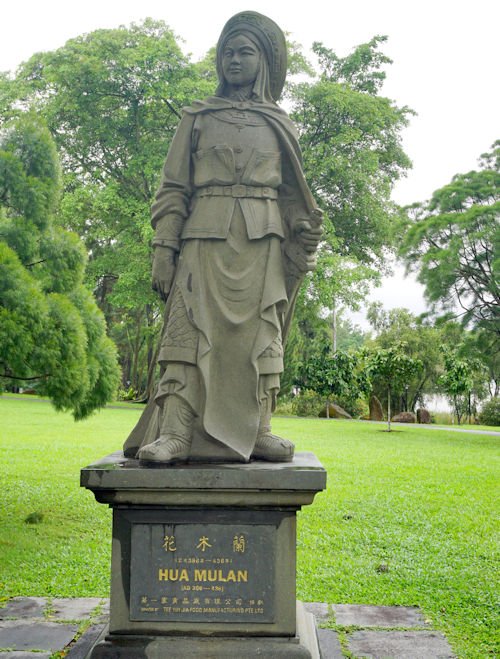
let’s consider the legend that Mulan comes from. According to ancient Chinese legend, Hua Mulan was a warrior woman
Figure 3: Hua Mulan
There are a few things
that are key in all the different versions of the stories I have read. First, Mulan entered the army in place of her
aging father, whom she loved, knowing he could not endure the viciousness of
war. Second, she always seems to have
hidden the fact that she was a woman until later in the story, and when it did
come out, that inspired her people.
Third, there is usually a love interest in the form of a military
commander. And fourth, she doesn’t seek
for riches from her fame and power, but only to do good for her people and her
family. Let’s go back to the
movie version by Disney®. Let’s lay out
the key concepts it shows us. To keep
these concepts separate and distinct, I will number them.
Mulan Concept 1 Protect the King at all Costs Do you remember what the
second scene was? Most of those
attending the Education Week class guessed the scene where Mulan is feeding the
chickens, but that is scene three. Some
even guessed the scene where Mulan is going to the matchmaker, but that is even
later. Let’s start with scene one. Scene one is when Shan Yu’s army comes up on
the Great Wall of China, and the fires are lit to tell China he is there. So, what is scene
two? In scene two, General Li goes into
the emperor’s palace and informs the emperor that Shan Yu’s army has crossed
the border. Then the general says he
will set up a perimeter around the palace to protect the emperor. The emperor, in his goodness, tells the
general to protect the people. Did you catch what
General Li was saying? Everything was
about protecting the emperor. This is
the idea of the game of chess.
Everything is set up to protect the king. It was as if the ordinary people were an
insignificant detail. But in the movie,
the emperor’s benevolence shows in his desire to protect his people, even over
his own safety. Even so, we see the
concept of chess in that scene, to protect the emperor at all costs, even over
the common people’s lives.
Mulan Concept 2 It Doesn’t Take a Whole Army to Win Another event of
interest to us occurs later in the movie.
When Mulan drops the avalanche on the Hun army, only four survive. You might think, okay, Mulan is a hero; she
goes home, roll the credits, end of the movie, we are happy, we feast. But that is not the case. The four, one of whom is Shan Yu, go into the
city to finish their job. All they have
to do is kill or capture the emperor to win, and they don’t need an entire army
to do that. What you see at that point
is the idea of a commando unit capturing the emperor or killing him.
Mulan Concept 3 Control of the Emperor is Control of China You may note that once
Shan Yu gets the emperor on the balcony in front of all the people, he then
tells the emperor to bow to him, claiming the emperor’s walls and cities have
fallen to Shan Yu. To us, this may seem
like someone who has lost his grip on reality.
He is in the midst of a huge city, surrounded by thousands, if not
millions, of people. Just below the
balcony on which he stands is the emperor’s army. This does not sound to us like what he
describes, fallen walls and cities. But
to Shan Yu, with the emperor standing before him as a prisoner, the statement
is very real. If Shan Yu controls the
emperor, he controls China.
Mulan Concept 4 Bow in Captivity or Die Shan Yu, holding the
emperor as his prisoner, now commands the emperor to bow to him. Every indication is that if the emperor bows,
his life will be spared, and he will be Shan Yu’s captive. In this situation, if the emperor does bow
and is put in captivity, the people will submit to the authority of Shan Yu. However, the emperor
refuses to bow. It is at this point that
Shan Yu is going to kill the emperor.
Through the movie, Shan Yu shows total disregard for the lives of
soldiers and ordinary people. But when
it comes to the emperor’s life, Shan Yu is willing to spare his life and take
him captive if the emperor will bow. It
is only when the emperor will not bow that Shan Yu chooses to take his
life. (Spoiler alert for those who
haven’t seen the movie. Mulan helps save
the emperor. I just saved you eight
dollars having to see the movie at the movie theater.) This shows Shan Yu’s
desire to have the emperor as a captive over killing him. This is very much like the book of Ether,
where the Jaredite kings tend to spare the life of the enemy leader, but not
the lives of other people. Remember in
Ether 8, King Jared’s army is destroyed but his life is spared.
Summary of Mulan Movie and Culture Matching the Jaredites . Though there is much of
Hollywood in the movie Mulan, in many respects it holds true to the traditional
story of Mulan found in books. In that
movie, we can see the very essence of the culture of the Jaredites. First, everything is done to protect the
king. His is the only life that seems to
be of much value. Second, it does not
take an entire army to win—a commando squad can win if they can kill or capture
the king. Third, control of the king is
control of the nation, whether he is dead or alive. And fourth, it is preferable to capture the
king and keep him in captivity instead of killing him. There is much to discuss in these
cultural ideas that may seem strange to us.
We will return to them in other discussions.
Bibliography [4] H. Murray,
A Brief History of Chess. New York and Tokyo: Ishi Press, 2015. [5] H. Nibley,
“The World of the Jaredites,” in The Collected Works of Hugh Nibley Volume 5,
Salt Lake City, Utah: Deseret Book Company, 1988, pp. 153–282.
[6] N.
Klimczak, “The Dramatic True Story Behind Disney’s Mulan,” 2020.
https://www.ancient-origins.net/history-famous-people/ballad-hua-mulan-legendary-warrior-woman-who-brought-hope-china-005084
(accessed Nov. 23, 2022). |